Wednesday, 13 February 2013

In the air on the way from the Falklands to Ascension (Feb. 12, Frithjof)


I am writing these lines in mid-air between the Falklands and Ascension Island (at about the latitude of Montevideo, heading NE). Aldo and I were picked up by Adrian from Kay’s this morning, together with Jacob (the Spanish ornithologist from Barcelona, who had studied microbial pathogens in penguins) and headed to RAF Mount Pleasant under a beautiful sunrise. We had an emotional farewell from Kay, who had now for the 3rd time given us a nice home in the Falklands, and we pledged to come back. Also Aldo was very nostalgic, he kept saying over the last few days that this was probably his last big trip down south (but he already told us this 2 years ago). At Mt. Pleasant, I briefly met and said farewell to Sarah Browning (Lee).
This is probably the moment to thank my great team members and those who have supported this expedition – especially (but not only) Kay McCallum, Paul Brickle, Paul Brewin, Sarah and Simon Browning, Stevie Cartwright, Graeme on Sea Lion Island. Matt Benwell and Jacob Gonzalez were great company over the last 10 days at SAERI. And special thanks to Dawn, Fiona, Ursula, John (x 2) and my other colleagues at Aberdeen for keeping things going during my absence, and to the School of Biological Sciences for letting me go in the middle of the teaching term which is something one can’t take for granted.
Indeed, leaving the Falklands behind and returning to the real world is not easy. The islands are among those places that I would consider paradise on Earth – a natural paradise, a largely intact, pristine environment, especially in the sea, and a small human population with a very high quality of life. In the rest of the world, the islands are mostly associated with the 1982 conflict, but it really should be said that since then, their inhabitants have turned them into a small model country. As a UK Overseas Territory with far-reaching autonomy, they are self-governing and self-reliant for almost everything except defence (which, for very obvious reasons, has to be provided by the UK). There is no unemployment in the islands, no crime, no drugs, no government debt, housing quality is good and very affordable, the economy has been buoyant for many years and will get even stronger. The community is small and very tight-knit, free of significant conflict or social issues, which makes this a very safe and pleasant place to live.
The only political statement that I am going to make in this blog is that I profoundly wish that the Falklands will be able to retain their freedom, sovereignty and self-determination as they are, and that they may never ever get annexed by Argentina. I feel that I have to make such a strong statement considering that the islands remain in the headlines throughout the world and the subject of considerable debate and controversy – but also, considering how few people will ever be able to visit the Falklands due to their remoteness and, thus, considerable difficulty and cost of getting there.
The Argentine claim is very far-fetched and unfounded indeed. I would consider it being driven entirely by nationalist, expansionist motives. Argentine governments have repeatedly used the Falklands “issue” whenever they needed to distract and deflect public attention from more serious, domestic issues. In recent years, the Argentine government – in particular under Nestor and Cristina Kirchner - has taken an increasingly aggressive approach to the Falklands once more, imposing trade and traffic embargoes, calling them a “colony” and lately even denying the existence of the Falkland Islanders - calling them “implanted colonists” (thus refusing to acknowledge that most Falkland Islanders have had 5 or more generations of ancestors living in the islands, which is as many or more than most residents of Argentina). The Argentine government repeatedly brings the case of the Falklands to the UN Committee for Decolonization in New York – refusing to acknowledge the right to self-determination of the islands’ inhabitants (a fundamental human right!) and even to discuss with their elected representatives. If anybody should decide the destiny of these islands, it is the Falkland Islanders. One might ask, what would actually be better if the islands were to be annexed by Argentina? Probably nothing, I would argue, but a lot of things would become worse. Certainly the situation of the Falkland Islanders would not improve, especially in terms of the quality of life or the economy in the islands. It is very unclear who would benefit from this, and likely the circumstances would be very unfair and uncontrollable by the islands’ residents.. Argentina is a country with serious problems in terms of its democratic culture (or rather, the lack of it), its bumpy economy, government debt and bankruptcy, organized crime, corruption, human rights record (the same dictatorship that invaded the Falklands in 1982, sacrificing many mostly young lives, is responsible for the disappearance of around 44,000 Argentine citizens) and still others. In the Falklands, these issues do not exist, and it is unthinkable that they ever would as long as the islands can retain their current political status. De facto, as they are, I would consider the Falklands being very close to an ideal world.
It also has to be remarked that there are no Argentine owners of land or other property in the Falklands, no Argentines were ever evicted, the Falklands have never been used as a basis for aggression against anybody, and there is no ethnic minority that would wish union with Argentina. An annexation by Argentina would force an alien sovereignty and identity upon a population that strongly rejects and despises such a move, de facto making them aliens in their home of several generations. In just a little over a month from now, the Falkland Islanders will have the opportunity to express their wishes on sovereignty in a referendum. This should send a clear message to the world community to accept the Falkland Islanders’ fundamental human right to freedom and self-determination without any further doubt. I wish the Falkland Islanders well in their endeavours, may the islands continue to flourish. And I also wish that at least some of our readers may be able to visit and experience this wonderful place themselves.

  Leaving Stanley at sunrise 


Above the tropical S Atlantic on the way from the FI to Ascension


Monday, 11 February 2013

Back to Stanley, diving in Port William and packing for the long trip back to Europe (Feb. 11, Frithjof)


I am writing today’s blog at SAERI – this is Aldo’s and my last day in the Falklands! We’ll be leaving for Ascension Island and the UK tomorrow morning – only Alexandra will be staying here for another 5 weeks.
The seaweed which Aldo collected in Port Philomel, West Falkland, indeed turned out to be the much-sought Cladochroa. Hoorray! Nobody had seen that thing for 110 years and our dear friend Aldo, 80 years young, rediscovered it within 15 min on a remote Falklands sea shore to which he had directed us with Google Earth. Phenomenal.
We returned to Stanley by Saturday early afternoon and spent the remainder of the day working on our many specimens from the West Island – not only Cladochroa. One of Kay’s great dinners followed, then back to the lab once more.

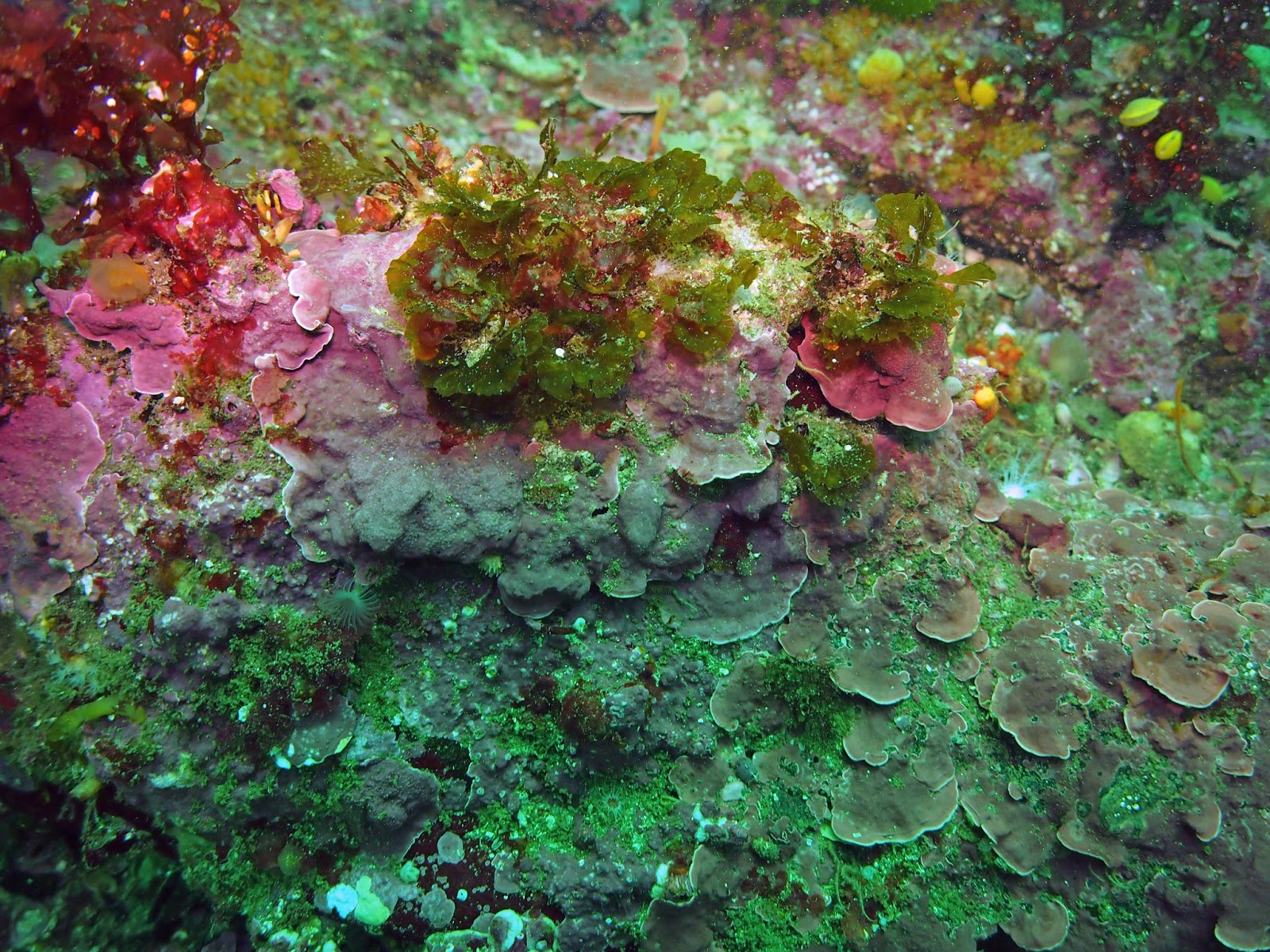
On Sunday morning, Sarah and Simon Browning picked up Alexandra and myself for a dive from Stevie Cartwright’s boat north of Stanley, in the large bay of Port William. The weather was perfect – hardly any wind, a cloudless sky. Summer! We got to today’s dive site in an approx. ½ h boat ride. Sarah, Simon and I went in. Fantastic conditions – crystal clear waters, sunlit, no current, no waves – this became probably the best dive of the entire expedition so far. We dived down to the lower depth limit of the giant kelp zone, to 20 m – where documented the seabed community by photography, with me collecting a large number of specimens in parallel. Collections included Syringoderma australe, a new brown algal record for the Falklands, which I had already found at nearby Beatrice Cove in Dec. 2010. Today we were able to better characterize its habitat and depth distribution.  On the way back, we met a pod of Peale’s Dolphins. Alexandra got a great shot of one of them leaping into the air next to the boat, and I got another one under water when I went in again just with mask, snorkel and fins. Really a dream  of a day. We finished lab work, prepared our specimens, and then had a great evening with Kay and Matt Benwell, a visiting scholar studying Argentine-British public perceptions of the Falklands issue.
The warm summer weather which we enjoyed so much had a serious downside though. In fact, we learned from a visiting Spanish ornithologist also working at SAERI, Jacob, that the unusually high temperatures in the 20s are quite a killer to Gentoo Penguin chicks. Their babies obviously cannot enter the water yet for cooling off (as the adults do), and their colonies are in shadowless terrain. He showed us some shocking footage from his cell phone camera of a totally exhausted Gentoo chick seeking rest in his shadow while he was working at the colony! He witnessed around 40 Gentoo chicks dying of heat exhaustion in a rather small colony during this sunny weekend alone. Quite obviously, for these penguins, even a low number of relatively hot days can be very problematic, while they probably would not suffer too much if just the average temperature was to go up by a degree or two. Conversely, all the penguin species living in climates warmer than here live in underground burrows and are thus much less affected by heat exhaustion.
Today is Monday, we are now at SAERI and packing up samples! Everything that Alexandra will no longer need can go back to Europe in my luggage. It’s a rainy day – I have to think that this at least is going to give the baby penguins a much-needed reprieve from the intense sun recently.
Tomorrow morning, Aldo and I will embark on our long trip back to Europe. A 3-day stopover in Ascension Island is awaiting us; on Sunday night Feb. 17, I’ll be back to Aberdeen. Alexandra has another 5 weeks in the Falklands to go, I can’t hide how much I envy her.

 Coralline algae at lower limit of kelp forest

 Simon Sarah and Frithjof about to dive

 Syringoderma australe

 Sarah at work in the giant kelp forest

  Lessonia 20 m deep

 Giant kelp

 Giant kelp

 Peales Dolpin in Pt William

Giant kelp

 Peale's dolphin 

Saturday, 9 February 2013

Exploring West Falkland (Feb. 9, Frithjof)


I am writing today’s blog on the ferry from Port Howard to New Haven, returning to East Falkland after a day and 2 nights in West Falkland, full of activities and experiences.
After a rich breakfast in the Port Howard Lodge, a historic metal-clad, wooden Falklands building (πιθανώς στοιχώμενο, η Αλεξάνδρα άκουσε παράξενα πράγματα αυτή τη νύχτα), we hit the dusty, bending road to the settlement of Dunnose Head on the west side of Port Philomel – a large natural inlet on the west side of West Falkland, where Skottsberg had found that mysterious Cladochroa around 110 years ago – and nobody had seen it ever since. West Falkland is even more sparsely populated and scenic than East Falkland. Thankfully, small dirt roads now connect all settlements, off-roading is no longer required but taking anything else than a 4WD over here still is not a good idea. The West Island has a very complex topography of mountain ranges, inlets, surrounding offshore islands and river systems. We passed the settlements of Chartres and Little Chartres (the latter is a lonely farm house with a barn and an aerogenerator) and, after around 2 ½ h we reached our much-sought destination. For Aldo, this clearly was a much-awaited moment for many years. He rushed to the intertidal and started searching, accompanied by Alexandra, while I got into my dry suit and started snorkelling in the 1-2 m shallow waters of this inlet. Within minutes, Aldo gave the victory sign – he had picked up something that matched Skottsberg’s historic drawing of Cladochroa. He showed it to Alexandra and myself, and we continued the hunt, picking up similar-looking things on the shore and in the shallow waters. Of course, only closer, microscopic inspection of the material back at SAERI in Stanley would tell us whether we had indeed in our hands what we were after.
The first and major objective of the long and expensive trip to West Falkland was met. We now drove back to the main road, and then to the twin settlements of Fox Bay East and Fox Bay West in the south of the West Island, taking fresh water samples from ponds and small rivers for Pieter’s oomycete isolation work on the way. Every sample was taken in a 15 ml Falcon tube, to which either sterile rice grains or hemp seeds were added as bait. We reached Fox Bay (I was wondering whether the name was a reminder of the now-extinct Warrah or Falkland Fox, hunted to extinction by the first farmers in the 19th century – Charles Darwin had still encountered these almost tame little predators). We did more snorkelling and intertidal collections in both Fox Bay East and Fox Bay West, and then drove back the long way to Port Howard. A huge dinner at the Lodge followed. I then retreated to my tent outside – the temperature was a lot milder than the previous night, but there was a howling storm – I needed ear plugs for being able to sleep! In the early morning hours, the gale subsided, a beautiful sunrise came up – I packed up the tent, loaded the car, we had an early breakfast and then drove onto the ferry. Alexandra and Aldo are catching up on some much-needed sleep while I am writing these lines and I am about to join them…
 One of the lonely roads of W Falkland

 Passage Islands off West Falkland

 Kays tent at Port Howard Lodge

 Alexandra and Aldo at Skottsbergs study site at NW Bay Pt Philomel

 Alexandra preparing oomycete isolates 

 Approaching NW Bay of Pt Philomel

 Fox Bay West 

 The Isthmus Nature Reserve West Falkland 

Fox Bay West

Fox Bay West

 Chartres River

Little Chartres

Uncontrolled peat fire

Pt Howard at dusk 

Alexandra trying out my dry suit 

Breakfast Pt Howard Lodge 

Historic telephone and exchange box Pt Howard Lodge 

Ο Σταύρος του Νότου και τα πρόβατα στο Port Howard, West Falkland The Southern Cross and the sheep in Port Howard, West Falkland (Feb. 7, Frithjof)


Μόλις ξάπλωσα στη σκηνή μου έξω από το Port Howard Lodge, στο μεγαλύτερο χωριό του West Falkland (με 100 κατοικούς πέριπου). Η πόρτα της σκηνής είναι ακόμη ανοιχτή – δεν θέλω να κλείσω ακόμη, δεν με νοιάζει ο παγερός άνεμος, μάλλον απολαμβάνω τη θέα πρός τον ουρανό και σκεφτόμουνα ότι θα ήταν μια καλή στιγμή να μοιραστώ λίγο από μια μεγάλη, ξανα αξέχαστη ημέρα στη νοτιά άκρη του κόσμου με τους διαβάτες μας. Εχουμε ξανά μια απίστευτη, όμορφη καλοκαιρινή ξαστεριά, βλέπω τον Ωρίονα και το Σταύρο του Νότου, τον γαλαξία μας... τ’αστέρια φαίνονται ξανά τόσο δυνατά!! Σκέψεις, όνειρα... Παράδεισος, πραγματικά...  και ακούω εκαντοτάδες πρόβατα!

I am writing these lines relaxing in my tent, gazing at the amazingly strong stars from the open tent door, not really minding the icy, mild breeze, and listening to the hundreds of sheep around me. The Southern Cross, Orion and the Milky Way above me, I can’t stop thinking how lucky we are to be here. Probably about as close to paradise as we could be tonight, even though a fairly cold one.

Tonight we are in Port Howard, the largest settlement (pop. around 100) in the huge West Island. Alexandra and Aldo each got a nice room in the beautiful historic, fairly posh Port Howard Lodge, while I pitched my tent outside on the lawn (between 2 artillery pieces which came here with lots of love from Argentina back in 1982 – back then, around 1000 Argie troops were based right here among around 50 locals).
Another great summer day in the Falklands has come to an end. It started with a frenzy of office and lab work at SAERI in Stanley, a meeting with Paul Brewin of the FI Fisheries Dept for discussing grant proposals, and then sorting out the remaining packing and logistics for our excursion to West Falkland.
We then got our new rental car, a 4WD Toyota Colorado, from a different company than last time – in fact, the only one that would allow a vehicle to be taken over to the remote West Falkland (after the experience of 2 flat tires we were rather relieved to be with a different company now).
I drove the team – Alexandra, Aldo and myself – to the ferry port at New Haven, about 20 miles west of Goose Green on Falkland Sound which took just over 2 h from Stanley. Again, awesome summer weather! In fact, New Haven is merely a pier next to a colony of gentoo penguins, there’s not even a single building of any sort. We boarded the small ferry, MV Concordia. Pre-booking is essential, since it has only a very small capacity for 10 vehicles at the most, even more so since it also carries all cargo between East and West Falkland. Passengers have to spend the 1 ½ - 2 hr crossing of the usually rough Falkland Sound waters in the small passenger cabin which is locked from the outside by water-tight hatches, nobody is allowed outside. The cars outside get heavily washed in sea water during the crossing.
Already during the approach to Port Howard we sensed that some splendid scenery would be awaiting us in the West Island which is even much more sparsely populated than East Falkland. We had dinner in the lodge, then Alexandra helped me to pitch the tent borrowed from Kay McCallum in Stanley, followed by updating specimen logs on our laptop for an hour and a half in the bar. Tomorrow we’ll be exploring several of Skottsberg’s study sites and type localities here in the West, especially around the large inlet of Port Philomel, which he had visited in the early 1900s, apparently without any phycologists (algal scientists) coming back since. We are particularly after the very enigmatic Cladochroa chnoosporiformis (Phaeophyta), which he described from Port Philomel, but which nobody else seems to have collected ever since. Who knows what we are going to find!!
Καλή νύχτα.


 Road traffic w lots of dust in the Falklands

With lots of love from Argentina
 
  
 Concordia Bay at New Haven

 
 Pt Howard

 Pt Howard

 Pt Howard